ARISTOTLE: Mature results of a phase 3 trial evaluating the addition of irinotecan to capecitabine chemoradiation in locally advanced rectal cancer (2025)

Type of publication:

Conference abstract

Author(s):

Sebag-Montefiore D.; Samuel L.; *Gollins S.; Glynne-Jones R.; Harte R.; West N.; Quirke P.; Myint A.S.; Bach S.; Falk S.; Parsons P.; Dhadda A.; Misra V.; Brown G.; Harrison M.; White L.; Duggan M.; Begum R.; Chang E.; Musleh R.; Lopes A.; Adams R.

Citation:

Radiotherapy and Oncology. Conference: ESTRO 2025. Vienna Austria. 206(Supplement 1) (pp S1192-S1194), 2025. Date of Publication: 01 May 2025

Abstract:

Purpose/Objective: To determine if the addition of irinotecan to capecitabine chemoradiation (CRT) improves disease-free survival in MRI-defined locally advanced rectal cancer (LARC). Material/Methods: ARISTOTLE (ISRCTN:09351447) is a phase III, multi-centre, open-label trial that randomly assigned (1:1) patients with MRI-defined LARC threatening or involving resection margins without metastases to pre-operative radiotherapy:45Gy/25 fractions combined with either capecitabine 900mg/m2 (CRT) or 650 mg/m2 bd weekdays with Irinotecan iv once-weekly 60mg/m2 (IrCRT) weeks 1-4. The primary endpoint is disease-free survival (DFS). Result(s): 75 UK sites randomised 564 eligible patients from 10/2011 to 07/2018; 284 to CRT and 280 to IrCRT. 66% male; median age 61 years (range:24-83). Radiological staging in both arms was similar:mrT3(77%), mrT4(16%); mrCRM involved(49%);resection margin threatened <=1mm(38%). Median follow-up is 62.1 months.Compared with CRT, IrCRT patients were less likely to receive 45Gy RT: 208(75%) vs 251(89%), p < 0.001; or receive >=90% capecitabine dose:187(68%) in IrCRT vs 253(89%) CRT, p < 0.001. 205(74%) IrCRT patients received >=90% irinotecan dose. >=Gd 3 non-haematological adverse events included fatigue 17(6%) vs 8(3%) p=0.06; diarrhoea:14% vs 4% p<0.001; abdominal pain 5% vs <1% p=0.001 for IrCRT and CRT respectively. >=Gd 3 haematological adverse events included leucopaenia: 9% vs 2%, p<0.001; neutropaenia: 10% vs 1%,p<0.001; and febrile neutropaenia: 1% vs <1% for IrCRT and CRT respectively. 5 patients had a grade 5 adverse event (3 lrCRT,2 CRT). The median time from the end of RT to surgery was 10.6 weeks. 238(85%) and 243(86%) patients underwent surgery in the IrCRT and CRT arms. The R0 resection rate was 90% vs 89% p=0.75 for IrCRT and CRT respectively. The pCR rate was 20% for IrCRT vs 18% for CRT p = 0.52. The rate of any post-surgical complications was similar in both arms:94(39%) for IrCRT and 91(37%) for CRT p=0.65). There is no evidence of a difference in loco-regional failure free (HR 0.94 [0.46-1.90]p=0.86, distant metastasis free (HR 0.89 [0.63-1.25] p=0.51), disease free HR 0.87 [0.64-1.18] p=0.37) or overall survival (HR 0.91[0.63-1.30],p=0.59) when IrCRT is compared with CRT. Conclusion(s): For patients with MRI-defined high risk LARC, low rates of CRM involvement and 36 month loco-regional failure were observed.The addition of irinotecan to CRT was associated with decreased radiotherapy and chemotherapy compliance and a higher rate of adverse events.There is no evidence of a difference in the pCR rate,36 month locoregional recurrence free or disease-free survival.

DOI: 10.1016/S0167-8140%2825%2900901-6

Link to full-text

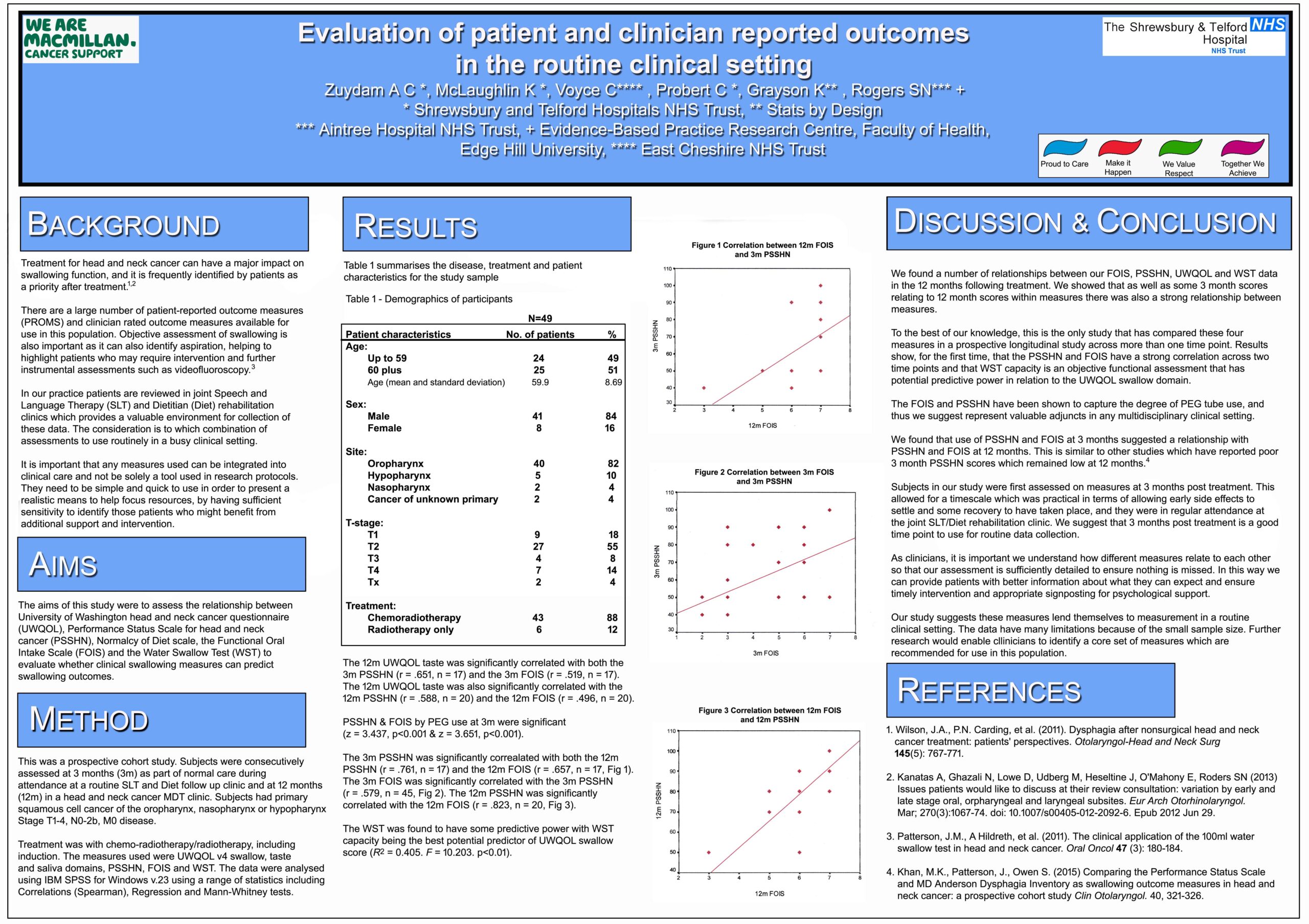
Evaluation of patient and clinician reported outcomes in the routine clinical setting (2017)

Type of publication:
Poster presentation

Author(s):
*Zuydam AC, Rogers SN, Grayson, *McLaughlin K, *Probert, Voyce C

Citation:
British Association of Health and Neck Oncologists, BAHNO Annual Scientific Meeting, Royal College of Physicians, London, Friday 12th May 2017

Abstract:
Treatment for head and neck cancer can have an impact on both swallowing function ,and quality of life. It is important that any measures used have sufficient sensitivity to highlight issues .The aims of this study were to assess the relationship between swallowing assessments and to evaluate whether clinical swallowing measures can predict swallowing outcomes.

Methods
This was a prospective cohort study. Subjects had Primary Squamous cell cancer of the oropharynx, nasopharynx or hypopharynx Stage T1‐4, N0‐ 2b, M0 disease. Treatment was with Chemo‐radiotherapy/ radiotherapy ,including induction.The measures used were University of Washington Quality of Life Questionnaire , Performance Status Scale Head and Neck Cancer ( PSSHN) Functional Oral Intake Scale( FOIS ) and the Water Swallow Test ( WST).

Results

Data were collected on 38 patients. The 3m PSSHN was significantly correlated with both the 12m PSSHN (r = .761) and the 12m FOIS (r = .657 ).The 3m FOIS was correlated with the 3m PSSHN (r = .662 ).The 12m PSSHN was significantly correlated with the 12m FOIS (r = .823). The WST was also found to potentially have some predictive power.

Conclusions
A number of measures were found to have clinical significance, and could be valuable to collect in a clinic setting.. Identification of relevant issues early on can enable clinicians to provide patients with information about what they can expect ,and ensure intervention is timely.

Link to poster [no password required]


Evaluation of nutritional status and PEG dependence during chemoradiotherapy (2017)

Type of publication:
Conference abstract

Author(s):
*McLaughlin K , *Zuydam A, *Probert C ,Voyce C ,Grayson K

Citation:
British Association of Health and Neck Oncologists, BAHNO Annual Scientific Meeting, Royal College of Physicians, London, Friday 12th May 2017

Abstract:
Background: Chemoradiotherapy treatment for head and neck cancer can cause significant adverse side-effects that have the potential to impair nutritional status, physical functioning and quality of life. The aims of the study were to measure nutritional status and use of enteral tube feeding at the end of treatment and 3 months post-treatment and to assess the relationship between these factors and patient reported outcomes.

Methods: Subjects treated with chemotherapy and/or radiotherapy with curative intent were recruited prospectively over 18 months. Data were collected on 33 subjects with a diagnosis of primary squamous cell carcinoma of the oropharynx, nasopharynx or hypopharynx stage T1-4, N0-2b, M0 disease at baseline, at end of treatment and 3 months post-treatment. Nutrition outcomes were weight, percentage weight change, gastrostomy dependence (days of PEG use) and percentage of nutritional requirements met orally and via PEG.

Results:
As expected baseline BMI was significantly lower at end of treatment and 3 months post-treatment compared to baseline. The mean percentage weight loss of 5.6% during treatment is comparable to other studies. Mean nutrition via PEG was 85.0% and 35.6% of requirements at end of treatment and 3 months post-treatment respectively. Mean PEG dependence at 3 months was 85 days. There was a trend towards significance for increased weight loss and days of PEG use at 3 months (r=0.406).

Conclusions:
The data show some interesting trends, however the small sample size limited statistical analysis. Further research with a larger cohort is required to explore the findings further.