

Using Trip Pro to locate evidence

Trip Pro is a database that can help you locate material such as guidelines, evidence summaries, systematic reviews and much more.

The basic version of Trip can be searched by anyone, but the NHS has made the Pro version available and this offers more systematic reviews, medical images and advanced search features.
Trip Pro can be accessed on any PC within Shrewsbury and Telford Hospital NHS Trust, and off-site access is available via an NHS OpenAthens account. When you login with NHS OpenAthens, Trip Pro will automatically provide you with links to full-text articles (where available) including those available through our journal subscriptions.

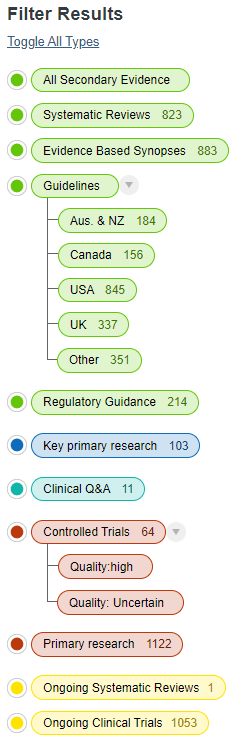
Trip offers a fairly basic interface, but you can filter results in a number of ways using the filters on the left-hand side. These include a filter for UK guidelines, making it easy to find any NICE guidance, along with guidance from Royal Colleges and other professional bodies. Trip claims to have the largest international collection of guidelines, and these can be filtered by region.

The filter for controlled trials offers an interesting feature whereby the RobotReviewer tool has been used to estimate the quality of trials as either 'high' or 'uncertain' based on the abstract, so a certain amount of critical appraisal has been carried out.

There are also filters for ongoing systematic reviews and clinical trials.

Although Trip Pro does not systematically search the journal literature, it does include a number of results classed as primary research, and these can be filtered to 'key primary research' or just 'primary research'. It's not clear how the distinction is made.

Trip offers a guide to which sources it searches.

Trip Pro searches a number of the resources that were covered by the NICE Evidence Search and is a partial replacement for it as NICE Evidence Search is closing at the end of March.




Finding improvement case studies

When looking at service development or improvement, the evidence can seem quite limited. In many cases other people may have implemented new ideas or services, but not written it up for publication in a journal.

The sources below provide case studies and examples of improvements or innovations, and may be useful as a way of learning from other people's experiences or getting ideas to implement in practice. It's not an exhaustive list and case studies will be available in other sources, such as individual Trust's websites.

Library staff can also find evidence to support you in developing services or innovations, and we offer an evidence search service.

Academy of Fabulous Stuff

Describes itself as ‘A social movement for sharing Health & Social Care Ideas, services and solutions that work’. Includes informal case studies of new innovations or ideas. The quality of reporting varies.

eWIN Workforce Information Network

eWIN is the NHS workforce information network designed to enable improvements in workforce development, efficiency and productivity.

To search, visit the Tools and Resources page, enter your search terms and select ‘Case Study’ before running the search.

Health Foundation

An independent charity committed to bringing about better health and health care for people in the UK. To find case studies, run a search and filter to ‘Improvement projects’.

NHS Confederation

Membership body that brings together and speaks on behalf of all organisations that plan, commission and provide NHS services.

To find case studies, run a search and filter to ‘Case studies’ (under ‘Category’) then click ‘Apply Filters’.

NHS England

Search the publications database, and filter to ‘Case studies’. This is a very small collection.

NHS Improvement

Visit the Resources page, run a search and filter to ‘Shared Learning’.

NHS Improvement and NHS England have merged so this website may change, but new resources are still being added as of February 2020.

NICE Local Practice Case Studies

A number of case studies around implementing NICE Guidance in practice.

BMJ Best Practice clinical decision tool

BMJ Best Practice is now available to all NHS organisation in England.

It provides access to the latest evidence-based information for healthcare professionals, structured around the patient consultation, with advice on symptom evaluation, test ordering, treatment approach and follow up. It also offers clinical calculators, patient information leaflets and some procedural videos.


Onsite at Shrewsbury and Telford Hospitals (SaTH) simply visit the BMJ Best Practice website for password-free access. You'll have the option to create a personal account to record usage for CME/CPD points.

For off-site access, you can use an NHS OpenAthens account. Visit the BMJ Best Practice website and login with your NHS OpenAthens account. You can also use a personal account created whilst on-site at SaTH.

Mobile apps are available for Android and iOS devices. These require a personal account to authenticate which can either be created whilst on-site on a SaTH PC, or off-site by logging in with NHS OpenAthens account and then registering for a personal account.

You'll also find BMJ Best Practice as an option in OmniSearch where it can be searched along with many other resources.

For more details or advice, pop into one of our libraries.

Searching for systematic reviews using Epistemonikos

If you're searching for systematic reviews of evidence, you may find Epistemonikos a useful resource. Unlike the Cochrane Library, this contains systematic reviews from many sources (it does also contain some primary research articles that have been included in the reviews, but the main focus is systematic reviews).

Systematic reviews are an excellent source of high-quality evidence, and should use a clearly formulated question and systematic and explicit methods to identify, select, and critically appraise relevant research, and collect and analyse data from the studies that are included in the review.

While most of the systematic reviews included will be included in other sources such as Medline and EMBASE, they are not always easy to locate (though we have added some search filters to the Knowledge Navigator page to make this easier).

We've added Epistemonikos to the Systematic Review section of our Knowledge Navigator, where you'll find useful guidance and sources for locating many different types of evidence. Alternatively, why not simply ask us to conduct an evidence search for you?.

UpToDate clinical decision support tool

To help towards Shrewsbury and Telford Hospital NHS Trust's goal of providing the safest, kindest care in the NHS, the Library, with the support of the Postgraduate and Undergraduate Education teams has started a subscription to the UpToDate clinical decision support resource.

UpToDate is written by clinicians for clinicians and offers easy access to high-quality information to inform diagnosis and treatment decisions. It has a proven positive impact on outcomes, and is associated with reduced cost of care, shorter length of stay, reduced complication rates and increased patient safety.

In an international subscriber survey carried out in 2014, 94% of respondents said UpToDate improved the quality of care they provide.

A recent survey of senior clinicians in SaTH gave examples of where using UpToDate has changed practice and was especially useful in rare or unusual conditions. It is also an excellent teaching resource, offers a drug interaction checker, can record usage for CPD points, and also offers hundreds of patient information leaflets.

UpToDate can be accessed on any PC in SaTH by visiting the UpToDate website. For off-site use, you can either create a username and password (useful if you want to record usage for CPD) or use your OpenAthens account. There is also a mobile app you can download for access anywhere.

For more information on accessing UpToDate off-site or by mobile app, visit the UpToDate page on our website.