Evolving to Involve: Transforming Observing Learners into Active Participants (2024)

Type of publication:

Poster presentation

Author(s):

*Dr Amy Ingham Farrow; *Dr Emily Thorley

Citation:

Journal of Healthcare Simulation 2024;4(Suppl 1):A67

Abstract:

Introduction:
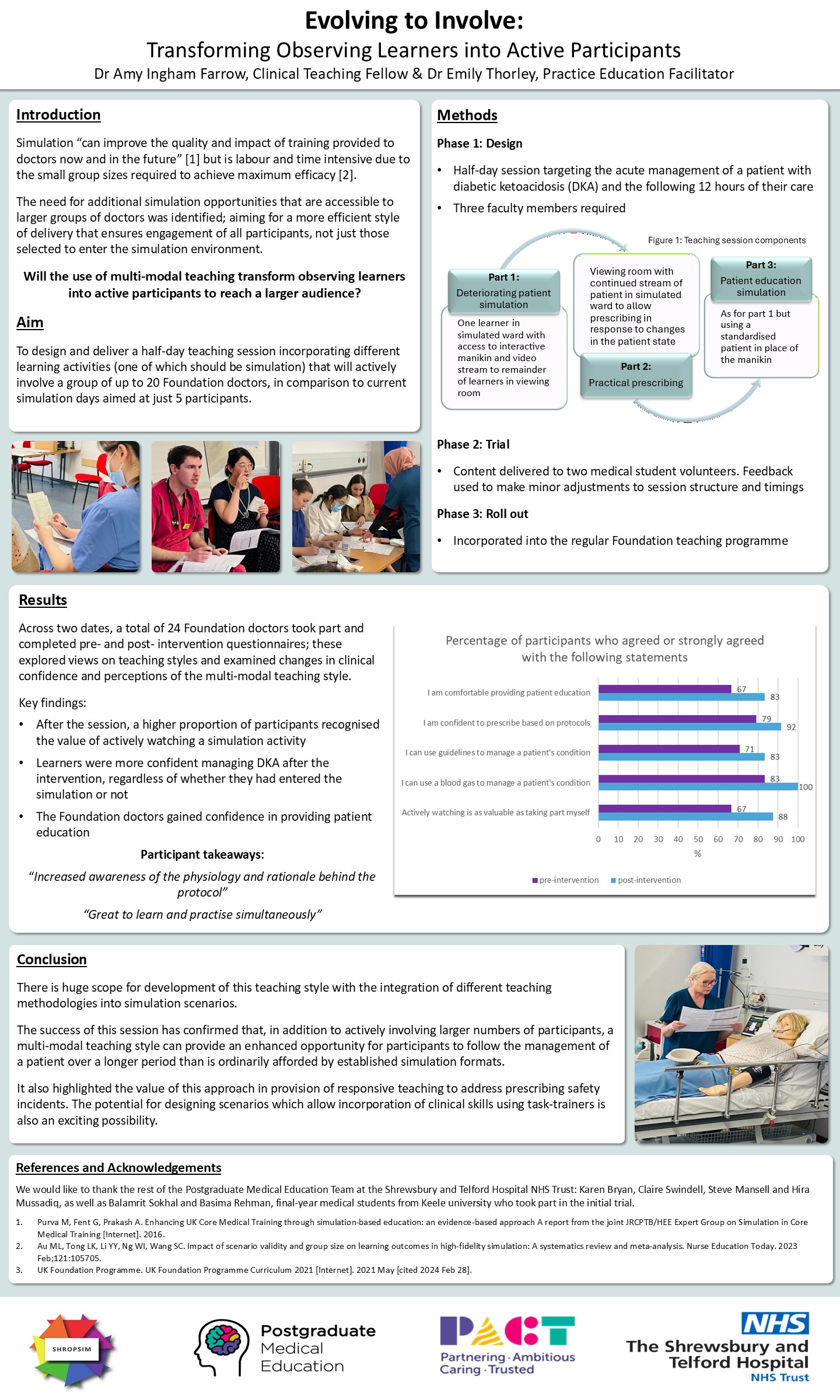
As an educational modality, simulation “can improve the quality and impact of training provided to doctors now and in the future” [1] but is labour and time intensive due to the small group sizes required to achieve maximum efficacy [2]. Foundation doctors currently undertake two and a half days of multidisciplinary simulation, with scenarios constructively aligned to their curriculum [3]. The need for additional simulation opportunities that are accessible to larger groups of doctors was identified. These sessions would require a more efficient style of delivery to ensure the engagement of all participants, not just those selected to enter the simulation environment. Could the use of multi-modal teaching transform observing learners into active participants to reach a larger audience?

Methods:
The three-part session was designed as an immersive simulation with an integrated interactive prescribing tutorial. This targeted the acute management of a patient with diabetic ketoacidosis and the following twelve hours of their care. The tutorial tasked all attendees (not just those involved in the simulation) with using the Trust protocol to prescribe appropriate treatment at various intervals in response to simulated clinical findings.

Pre- and post-intervention questionnaires explored participants’ views on styles of teaching and examined any changes in clinical confidence and perceptions around the multi-modal teaching style.

Results:
Responses were collected from sixteen Foundation Year 2 doctors who attended the two-hour training afternoon as part of their teaching programme. Data indicated an increase in numbers who agreed or strongly agreed that actively watching scenarios was as valuable as taking part themselves. Additionally, doctors were more confident prescribing treatments based on Trust protocols and were more comfortable using Trust guidelines to manage an unwell patient. Naturally, some challenges arose, with minor changes needed before we repeat this with Foundation Year 1 doctors.

Discussion:
There is huge scope for development of scenarios that integrate different teaching methodologies into simulation-based training. The success of this session has confirmed that, in addition to actively involving larger numbers of participants, a multi-modal teaching style can provide an enhanced opportunity for participants to follow the management of a patient over a longer period than is ordinarily afforded by established simulation formats. It also highlighted the value of this approach in provision of responsive teaching to address prescribing safety incidents. The potential for designing scenarios which allow incorporation of clinical skills using task-trainers is also an exciting possibility.

References:
1. Purva M, Fent G, Prakash A. Enhancing UK Core Medical Training through simulation-based education: an evidence-based approach A report from the joint JRCPTB/HEE Expert Group on Simulation in Core Medical Training [Internet]. 2016. Available from: https://www.jrcptb.org.uk/sites/default/files/HEE_Report_FINAL.pdf

2. Au ML, Tong LK, Li YY, Ng WI, Wang SC. Impact of scenario validity and group size on learning outcomes in high-fidelity simulation: A systematics review and meta-analysis. Nurse Education Today. 2023 Feb;121:105705.

3. UK Foundation Programme. UK Foundation Programme Curriculum 2021 [Internet]. 2021 May [cited 2024 Feb 28]. Available from: https://healtheducationengland.sharepoint.com/sites/UKFPOT/WebDocs/Forms/AllItems.aspx?id=%2Fsites%2FUKFPOT%2FWebDocs%2F4%2E%20Curriculum%2FUKFP%20Curriculum%202021%5FOct22%20update%2Epdf&parent=%2Fsites%2FUKFPOT%2FWebDocs%2F4%2E%20Curriculum&p=true&ga=1

Link to abstract [no password required]

Link to poster [no password required]

Prostate cancer care in the Middle East and North Africa: a comprehensive practice survey (2024)

Type of publication:

Conference abstract

Author(s):

Al-Samarat F.; *Alrawashdeh A.; Ibrahim R.; Khatib S.; Alrawashdeh K.; Salem A.;

Citation:

Radiotherapy and Oncology. Conference: ESTRO 2024. Glasgow United Kingdom. 194(Supplement 1) (pp S2796-S2798), 2024. Date of Publication: 01 May 2024.

Abstract:

Purpose/Objective: Prostate cancer is the second most common cancer and the fifth leading cause of cancer mortality in men worldwide (1). Prostate cancer is categorized into prognostic groups according to the results of prostate biopsy (Gleason score), prostate-specific antigen (PSA) at diagnosis and tumor stage (2). Treatment options are informed based on the cancer risk group and the patient's general health (2). The purpose of this study is to quantify current prostate cancer care practices in the Middle East and North Africa (MENA) to identify areas for improvement in the diagnosis and treatment while assessing how closely the current practices align with international practice guidelines Material/Methods: A Google questionnaire aligned with the European Society for Medical Oncology (ESMO) clinical practice guidelines for prostate cancer diagnosis, staging, and treatment was created and electronically distributed to healthcare professionals in the MENA region. The questionnaire contained inquiries about the approaches employed for prostate cancer assessment and treatment. It also assessed the accessibility of these methods in the participants' clinical settings. Result(s): Responses from 22 doctors across 11 different countries from the MENA region were received. These responses were from 9 (40.9%) medical oncologists, 4 (18.2%) radiation oncologists, 3 (13.6%) clinical oncologists, 1 (4.5%) surgical oncologist and 1 (4.5%) family doctor as well as 4 (18.2%) unknown specialties. Among these respondents, 9 (40.9%) doctors practiced in public hospitals, 8 (36.4%) in academic hospitals and 5 (22.7%) in private hospitals. Regarding diagnostic and staging methods utilized, the majority of respondents (N=15, 68.2%) reported the use of multiparametric MRI. A significant proportion of the respondents routinely perform transrectal ultrasound-guided biopsies (N=22, 90.9%), while 18 (81.8%) respondents reported employing bone scans for metastasis detection in patients with intermediate and high-risk prostate cancer. N=8 (36.4%) of the respondents use prostate-specific membrane antigen (PSMA) PET as a routine staging modality (Figure 1). For the treatment of localized intermediaterisk prostate cancer, 21 of 22 doctors (95.5%) offer at least one treatment that that is in agreement with international practice guidelines (radical prostatectomy +/- pelvic lymph node dissection, (N=8, 38.1%) or radiotherapy +/- androgen deprivation therapy (N=17, 80.9%). 3 out of 22 doctors (13.6%) offer at least one treatment that is not in agreement with international standards (e.g. androgen deprivation therapy alone). For localized highrisk prostate cancer, 20 out of 22 doctors (90.9%) offer at least one treatment that that is in agreement with international practice guidelines including radiotherapy with androgen deprivation therapy (N=14, 70%) or radiotherapy, androgen deprivation therapy and abiraterone/docetaxel (N=9, 45%), radical prostatectomy +/- pelvic lymph node dissection (N=2, 9%), 2 out of 22 (9%) offer at least one treatment that is not in agreement with international standards (androgen deprivation therapy alone (N=1, 16.6%) and brachytherapy alone (N=1, 16.6%)). Regarding the availability of treatment modalities, 20 (90.9%) respondents indicated access to radiotherapy, 4 (20%) have access to brachytherapy, 15 (75%) have access to advanced external beam radiotherapy techniques (volumetric modulated arc therapy, intensity-modulated radiotherapy) and 4 (18.2%) have access to robotic prostatectomy (Figure 2). Conclusion(s): The results demonstrated suboptimal use of multiparametric MRI at the time of initial diagnosis and staging of prostate cancer. Additionally, the results indicate suboptimal use of bone scans for staging of patients with intermediate-risk and high-risk disease. A minority of participants reported inappropriate management of localized intermediate- and high-risk prostate cancer. Furthermore, limited access to brachytherapy, robotic prostatectomy, and to a lesser extent advanced radiotherapy techniques was found. This study could guide future MENA prostate cancer policies and direct funds.

DOI: 10.1016/S0167-8140%2824%2901557-3

Monoclonal Gammopathy of Multisystemic Significance: A Challenging Diagnosis of Light Chain Amyloidosis (2024)

Type of publication:

Journal article

Author(s):

*Owolabi, Olasunkanmi; *Yera, Hassan O; *Jenkins, Kathryn; *Pakala, Vijay; *Kundu, Suman.

Citation:

Cureus. 16(10):e72010, 2024 Oct.

Abstract:

We present a case of a 51-year-old woman diagnosed with light chain amyloidosis associated with monoclonal gammopathy of undetermined significance (MGUS). Initially, she presented with symptoms of heart failure, including palpitations, chest tightness, and shortness of breath, which were attributed to myocarditis based on cardiac magnetic resonance (CMR) imaging findings. However, her condition rapidly deteriorated, with recurrent admissions for worsening heart failure, cardiogenic shock, and stroke. A cardiac biopsy ultimately confirmed light chain amyloidosis, a rare complication of MGUS, which has a long-term risk of 0.8% in patients with light chain MGUS. Despite aggressive treatment, including chemotherapy and biventricular assist device implantation, her condition continued to decline, and she became ventilator-dependent and subsequently passed away. This case highlights the importance of considering amyloidosis in patients with MGUS and underscores the need for early diagnosis and intervention to prevent catastrophic outcomes.

Link to full-text [open access - no password required]

Enhancing Junior Doctors' Preparedness and Satisfaction in Trauma and Orthopaedics: A Quality Improvement Project With the Development of a Comprehensive Guidebook (2024)

Type of publication:

Journal article

Author(s):

Mohammed, Ghulam Dastagir Faisal; *Younis, Zubair; Amin, Jebran; Mansoor, Zaina; Lingnau, Leonie; Jesudason, Edwin P.

Citation:

Cureus. 16(9):e70061, 2024 Sep.

Abstract:

BACKGROUND: Junior doctors often feel underprepared for their trauma and orthopaedics (T&O) rotation due to limited exposure during medical school and inadequate support. This project aimed to enhance junior doctors' preparedness and satisfaction during their T&O rotation by developing a comprehensive guidebook that addresses key orthopaedic knowledge and logistical challenges. METHODS: A quality improvement project (QIP) was conducted at Ysbyty Gwynedd Hospital. Initial surveys identified factors contributing to poor experiences during the trauma and orthopaedics rotation, including limited knowledge of orthopaedic emergencies and a lack of useful reference resources. A guidebook was developed and refined through multiple plan-do-study-act (PDSA) cycles. The guidebook covered topics such as orthopaedic emergencies, common injuries, referral pathways, and hospital logistics, presented in an accessible flowchart format. RESULTS: The primary objective of achieving 75% satisfaction among junior doctors was successfully met, with satisfaction increasing from four (40%) to eight (80%) doctors in the most recent survey. Secondary outcomes included a marked improvement in the understanding of quality improvement projects, rising from three (30%) to eight (80%) doctors. Orthopaedic knowledge also saw a significant enhancement, increasing from four (40%) to nine (90%) doctors. Confidence in handling night on-call duties improved dramatically, with all 10 doctors (100%) reporting increased confidence, compared to four (40%) doctors initially. Additionally, seven doctors (70%) expressed a greater interest in pursuing a career in orthopaedic surgery. CONCLUSION: The comprehensive guidebook significantly improved junior doctors' preparedness and satisfaction during their T&O rotation. While the guidebook is a valuable resource, ongoing mentorship and hands-on experience remain essential for long-term success. Replication of this project across other departments and hospitals is recommended to assess its broader applicability and impact.

Link to full-text [open access - no password required]

Patient with Pneumomediastinum and Pneumoperitoneum-Importance of Human Factors (2024)

Type of publication:

Conference abstract

Author(s):

*Lakshmipathy G.R.; *Ball W.

Citation:

British Journal of Surgery. Conference: Annual Congress of the Association of Surgeons of Great Britain and Ireland. Belfast United Kingdom. 111(Supplement 8) (pp viii119), 2024. Date of Publication: September 2024.

Abstract:

Clinical assessment: 70-year-old lady presents with one-day history of dyspnoea, chest and abdominal pain. She was recently discharged following a three-week hospital admission with fall related traumatic rib fractures and hospital acquired pneumonia. Her abdomen was soft and non-tender. CT scan with oral and IV contrast demonstrates pneumomediastinum and pneumoperitoneum with connection at diaphragmatic crura. Management: Patient was managed conservatively however two days after admission her CRP climbed to 150 and clinical suspicion remained high. Repeat CT scan over the weekend demonstrated increase in the pneumoperitoneum and decrease in the pneumomediastinum with a collection around sigmoid colon. Trainee raised concern to consultant and a laparotomy was done. Operative findings showed perforated sigmoid colon with faeculent peritonitis of unclear cause. Hartmann's procedure was done and patient continued post recovery in ITU. Discussion(s): This case demonstrates the complex varying presentations of our elderly co-morbid population. The presence of air in thoracic and abdominal cavities with unknown cause weeks after the fall was suspicious. Hence, the team communicated well from top-down and likewise from weekday to weekend. Low threshold for escalation and high index of suspicion enabled a re-scan which proved to be life-saving for this patient. Identifying complicated cases where errors can occur is a critical first step. Clear communication among staff, accurate documentation and addressing the patient concerns enabled the surgical team to navigate the complex disease process and ensure safe patient care.

Link to full-text [no password required]

The OBS UK Dashboard: an interactive tool for representative trial site selection to facilitate equality and diversity in maternity research (2024)

Type of publication:

Journal article

Author(s):

*Elsmore, Amy; Rai, Tanvi; Pallmann, Philip; Townson, Julia; Kotecha, Sarah; Black, Mairead; Sanders, Julia; Collis, Rachel; Collins, Peter; Karunakaran, Bala; Wu, Pensee; Bell, Sarah; *Parry-Smith, William

Citation:

Trials. 25(1):629, 2024 Sep 27.

Abstract:

BACKGROUND: Obstetric Bleeding Study UK (OBS UK) (award ID: 152057) is a National Institute for Health and Care Research (NIHR)-funded stepped wedge cluster randomised controlled trial of a complex intervention for postpartum haemorrhage. This was developed in Wales and evaluated in a feasibility study, with improvements in maternal outcomes observed. Generalisability of the findings is limited by lack of control data and limited ethnic diversity in the Welsh obstetric patient population compared to the United Kingdom (UK): 94% of the Welsh population identifies as White, versus 82% in the UK. Non-White ethnicity and socioeconomic deprivation are linked to increased risk of adverse maternal outcomes. traditionally, decisions regarding site selection are based on desire to complete trials on target in 'tried and tested' research active institutions. To ensure widespread applicability of the results and investigate the impact of ethnicity and social deprivation on trial outcomes, maternity units were recruited that represent the ethnic diversity and social deprivation profiles of the UK. METHOD: Using routinely collected, publicly available data, an interactive dashboard was developed that demonstrates the demographics of the population served by each maternity unit in the UK, to inform site recruitment. Data on births per year, ethnic and socioeconomic group of the population for each maternity unit, across the UK, were integrated into the dashboard. RESULTS: The dashboard demonstrates that OBS UK trial sites reflect the ethnic and socioeconomic diversity of the UK (study vs UK population ethnicity: White 79.2% vs 81.7%, Asian 10.5% vs 9.3%, Black 4.7% vs 4.0%, Mixed 2.5% vs 2.9%, Other 3.0% vs 2.1%) with variation in site demography, size and location. Missing data varied across sites and nations and is presented. CONCLUSION: The NIHR equality, diversity and inclusion strategy states studies must widen

Link to full-text [open access - no password required]

Altmetrics:

BTS Position Statement on Sustainability and the Environment: Climate Change and Lung Health (2024)

Type of publication:

National guidance

Author(s):

Laura-Jane Smith, Henry Marshall, Thomas Medveczky, *Jennifer Nixon, Gerrard Phillips, Ravijyot Saggu, Lewis Standing, Ruth Wiggans, Alexander Wilkinson

Citation:

British Thoracic Society 2024

Link to full-text [no password required]

LBA70 Adding metformin to androgen deprivation therapy (ADT) for patients (pts) with metastatic hormone sensitive prostate cancer (mHSPC): Overall survival (OS) results from the multi-arm, multi-stage randomised platform trial STAMPEDE (2024)

Type of publication:

Conference abstract

Author(s):

Gillessen S.; Murphy L.R.; James N.D.; Sachdeva A.; Attard G.; Jones R.J.; Adler A.; El-Taji O.; Varughese M.; Gale J.; Brown S.J.; Srihari N.N.; Millman R.; Matheson D.; Amos C.L.; Murphy C.; McAlpine C.; Parmar M.K.; Brown L.C.; Clarke N.

Citation:

Annals of Oncology. Conference: ESMO Congress 2024. Barcelona Spain. 35(Supplement 2) (pp S1258-S1259), 2024. Date of Publication: September 2024.

Abstract:

Background: Metformin is a widely used, well tolerated anti-diabetic agent. Several studies suggest metformin has anti-cancer activity in different malignancies, including prostate cancer. We hypothesised that metformin also reduces the development of ADT-induced metabolic adverse effects, possibly improving OS via these mechanisms. Method(s): Non-diabetic pts with mHSPC were randomly allocated 1:1 to standard of care (SOC) or SOC+metformin within STAMPEDE. SOC included ADT +/- radiotherapy +/- docetaxel +/- androgen receptor pathway inhibitor (ARPI). The primary outcome was OS. Target hazard ratio (HR) 0.8 (92% power, 2.5% 1-sided significance). 7 subgroup analyses were pre-specified but not pre-powered. Result(s): 1874 pts with mHSPC were randomised Sep2016-Mar2023. Arms were well balanced: median age 69 years, IQR 63-73; median PSA 84ng/ml, IQR 24-352; de novo 1758 (94%) vs relapsed 116 (6%). Planned SOC included 82% Docetaxel and 3% ARPI. After a median follow-up of 60 months, the HR for OS between arms was 0.91 (p=0.148; 95% CI 0.80-1.03). The median (95%CI) OS was 63 (58-69) and 69 (63-73) months in the SOC and SOC+metformin arms respectively. In patients with high versus low volume disease (CHAARTED def), HR was 0.79 (p=0.006; 0.66-0.93) and 1.0 (p=0.992; 0.79-1.26) respectively. The interaction p-value = 0.086. For progression-free survival: Overall HR was 0.92 (p=0.164; 0.81-1.04) with HRs of 0.76 (p=0.001; 0.64-0.89) and 1.10 (p=0.401; 0.88-1.37) in the high and low volume subgroups respectively, interaction p-value = 0.006. Metabolic parameters that improved significantly with metformin included reduced weight gain, fasting glucose, HbA1c and total and LDL cholesterol. Fewer patients developed a metabolic syndrome. Adverse events (AE) >=grade 3 were reported in 52% and 57% in the SOC and SOC+metformin arms, respectively; Gastrointestinal AEs increased with metformin. Conclusion(s): Metformin does not improve survival in unselected metastati

Link to full-text [no password required]

Interpretable Machine Learning for Predicting Multiple Sclerosis Conversion from Clinically Isolated Syndrome (2024)

Type of publication:
Journal article

Author(s):
Daniel E.C.; Tirunagari S.; Batth K.; Windridge D.; *Balla Y.

Citation:
medRxiv. (no pagination), 2024. Date of Publication: 19 Jul 2024. [preprint]

Abstract:
Background: Machine learning (ML) prediction of clinically isolated syndrome (CIS) conversion to multiple sclerosis (MS) could be used as a remote, preliminary tool by clinicians to identify high-risk patients that would benefit from early treatment. Objective(s): This study evaluates ML models to predict CIS to MS conversion and identifies key predictors. Method(s): Five supervised learning techniques (Naive Bayes, Logistic Regression, Decision Trees, Random Forests and Support Vector Machines) were applied to clinical data from 138 Lithuanian and 273 Mexican CIS patients. Seven different feature combinations were evaluated to determine the most effective models and predictors. Result(s): Key predictors common to both datasets included sex, presence of oligoclonal bands in CSF, MRI spinal lesions, abnormal visual evoked potentials and brainstem auditory evoked potentials. The Lithuanian dataset confirmed predictors identified by previous clinical research, while the Mexican dataset partially validated them. The highest F1 score of 1.0 was achieved using Random Forests on all features for the Mexican dataset and Logistic Regression with SMOTE Upsampling on all features for the Lithuanian dataset. Conclusion(s): Applying the identified high-performing ML models to the CIS patient datasets shows potential in assisting clinicians to identify high-risk patients.

Link to full-text [open access - no password required]

Clinical decision support systems for maternity care: a systematic review and meta-analysis (2024)

Type of publication:
Journal article

Author(s):
Cockburn N.; Osborne C.; Withana S.; *Elsmore A.; *Nanjappa R.; South M.; *Parry-Smith W.; Taylor B.; Chandan J.S.; Nirantharakumar K.

Citation:
eClinicalMedicine. 76 (no pagination), 2024. Article Number: 102822. Date of Publication: October 2024.

Abstract:
Background: The use of Clinical Decision Support Systems (CDSS) is increasing throughout healthcare and may be able to improve safety and outcomes in maternity care, but maternity care has key differences to other disciplines that complicate the use of CDSS. We aimed to identify evaluated CDSS and synthesise evidence of their impact on maternity care. Method(s): We conducted a systematic review for articles published before 24th May 2024 that described i) CDSS that ii) investigated the impact of their use iii) in maternity settings. Medline, CINAHL, CENTRAL and HMIC were searched for articles relating to evaluations of CDSS in maternity settings, with forward- and backward-citation tracing conducted for included articles. Risk of bias was assessed using the Mixed Methods Assessment Tool, and CDSS were described according to the clinical problem, purpose, design, and technical environment. Quantitative results from articles reporting appropriate data were meta-analysed to estimate odds of a CDSS achieving its desired outcome using a multi-level random effects model, first by individual CDSS and then across all CDSS. PROSPERO ID: CRD42022348157. Finding(s): We screened 12,039 papers and included 87 articles describing 47 unique CDSS. 24 articles (28%) described randomised controlled trials, 30 (34%) described non-randomised interventional studies, 10 (11%) described mixed methods studies, 10 (11%) described qualitative studies, 7 (8%) described quantitative descriptive studies, and 7 (8%) described economic evaluations. 49 (56%) were in High-Income Countries and 38 (44%) in Low- and Middle-Income countries, with no CDSS trialled in both income categories. Meta-analysis of 35 included studies found an odds ratio for improved outcomes of 1.69 (95% confidence interval 1.24-2.30). There was substantial variation in effects, aims, CDSS types, context, study designs, and outcomes. Interpretation(s): Most CDSS evaluations showed improvements in outcomes, but there was heterogeneity in all aspects of design and evaluation of systems. CDSS are increasingly important in delivering healthcare, and Electronic Health Records and mHealth will increase their availability, but traditional epidemiological methods may be limited in guiding design and demonstrating effectiveness due to rapid CDSS development lifecycles and the complex systems in which they are embedded. Development methods that are attentive to context, such as Human Centred Design, will help to meet this need.

Link to full-text [open access - no password required]

Altmetrics: