

Using Trip Pro to locate evidence

Trip Pro is a database that can help you locate material such as guidelines, evidence summaries, systematic reviews and much more.

The basic version of Trip can be searched by anyone, but the NHS has made the Pro version available and this offers more systematic reviews, medical images and advanced search features.
Trip Pro can be accessed on any PC within Shrewsbury and Telford Hospital NHS Trust, and off-site access is available via an NHS OpenAthens account. When you login with NHS OpenAthens, Trip Pro will automatically provide you with links to full-text articles (where available) including those available through our journal subscriptions.

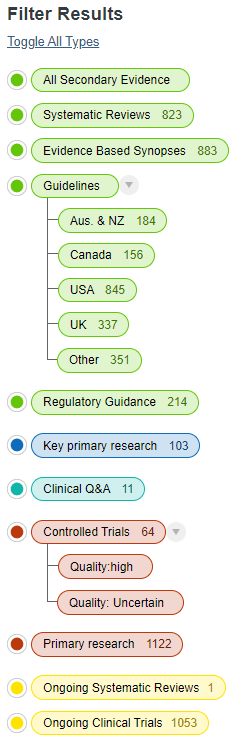
Trip offers a fairly basic interface, but you can filter results in a number of ways using the filters on the left-hand side. These include a filter for UK guidelines, making it easy to find any NICE guidance, along with guidance from Royal Colleges and other professional bodies. Trip claims to have the largest international collection of guidelines, and these can be filtered by region.

The filter for controlled trials offers an interesting feature whereby the RobotReviewer tool has been used to estimate the quality of trials as either 'high' or 'uncertain' based on the abstract, so a certain amount of critical appraisal has been carried out.

There are also filters for ongoing systematic reviews and clinical trials.

Although Trip Pro does not systematically search the journal literature, it does include a number of results classed as primary research, and these can be filtered to 'key primary research' or just 'primary research'. It's not clear how the distinction is made.

Trip offers a guide to which sources it searches.

Trip Pro searches a number of the resources that were covered by the NICE Evidence Search and is a partial replacement for it as NICE Evidence Search is closing at the end of March.


Library apps for knowledge on the move

We have a growing range of apps available for our resources, to make accessing information on the go even easier, in some cases even when offline.


The library itself doesn't have a mobile app, but our website is responsively designed to work on any size screen.

UpToDate

Android | iOS

UpToDate is an evidence-based knowledge system that helps clinicians make the right decisions at the point of care. It contains over 10,000 articles, providing evidence-graded treatment recommendations as well as diagnostic and other information for common as well as rare conditions. It also offers thousands of images, clinical calculators and a drug interactions checker.

The mobile app is available to SaTH staff and requires the use of a personal registration created whilst using UpToDate on-site.

BNF (British National Formulary) and BNF for Children

Android | iOS

The BNF/BNFC app is aimed at prescribers, pharmacists, and other healthcare professionals who need sound, up-to-date information about the use of medicines. It combines the content from the BNF and BNFC, ensuring easy access to BNF information wherever you are.

No authentication required. Works offline.

BMJ Best Practice

Android | iOS

BMJ Best Practice provides access to the latest evidence-based information for healthcare professionals, structured around the patient consultation with advice on symptom evaluation, test ordering, treatment approach and follow up. It also offers clinical calculators, patient information leaflets and some procedural videos.

The mobile app is available to all NHS staff and authentication requires a personal account, which can be created whilst on-site on a SaTH PC, or whilst logged in with an NHS OpenAthens account. Works offline.

Adobe Digital Editions

Android | iOS

Adobe Digital Editions is required to download our e-books to your mobile device for offline reading. Free registration for an Adobe ID required, and an NHS OpenAthens account is required to access and download e-books to your device. Our guide to downloading e-books gives more details.

BMJ Case Reports: share and learn from interesting cases

We've just renewed our subscription to BMJ Case Reports, a collection of over 15,000 case reports across all fields of medicine. Publishing a case report is a great way to share details of interesting cases on common and rare diseases.

Shrewsbury and Telford Health Libraries have a fellowship account on behalf of SaTH, and as well as allowing you to access the full-text of all the cases via an NHS OpenAthens account or on any SaTH PC, you can also submit case reports for publication without having to pay publication fees. Case reports submitted for publication are peer-reviewed quickly, usually appearing in the journal within 25 days, and BMJ Case Reports is indexed in the Medline database.

A number of case reports by Shrewsbury and Telford Hospital NHS Trust staff have already been published.

If you want to submit a case report, our fellowship number is 915046 and instructions for authors can be found on the BMJ Case Reports website.

New E-learning Module on how to Search the Healthcare Databases

Health librarians, in collaboration with Health Education England have produced a set of e-learning modules on how to search the literature effectively and have recently added a new module on how to search the healthcare databases using the NICE interface.

This builds on the earlier modules that look at the principles behind searching.

All of the modules are short (each taking no more than 20 minutes to complete) and may be ‘dipped into’ for reference, or completed to obtain a certificate. There are now seven modules suitable for novice searchers and those wishing to refresh their knowledge:

Building the foundations

Developing the skills

You'll need an OpenAthens account to access the modules (and all the many other e-learning packages available on the e-LfH platform) and the first time you access e-LfH you'll need to enter some personal details.

Library staff can also provide training and assistance with searching techniques and searching specific resources, and we can also perform searches on your behalf.

E-learning modules on literature search skills available

Health librarians, in collaboration with Health Education England have produced a set of e-learning modules on how to search the literature effectively.

These look at the principles behind searching, so the skills are applicable to any database you may use for searching the literature, including those in the OmniSearch article search, and the NICE advanced database (HDAS) search.

The modules are short (each taking no more than 20 minutes to complete) and may be ‘dipped into’ for reference, or completed to obtain a certificate. There are currently six modules suitable for novice searchers and those wishing to refresh their knowledge:

Building the foundations

Developing the skills

You'll need an OpenAthens account to access the modules (and all the many other e-learning packages available on the e-LfH platform) and the first time you access e-LfH you'll need to enter some personal details.

Library staff can also provide training and assistance with searching techniques and searching specific resources, and we can also perform searches on your behalf.