Library survey results

Earlier this year, we carried out a survey of our users to find out what you thought about the library service. In all, we had 114 responses, and lots of positive comments and examples of the impact our services have had.

We asked respondents that had used our services in the last 12 months to rate the overall service to them. 85% rated us as excellent, with another 15% rating us as good and 2% as satisfactory. No respondents rated the service as inadequate.

There were lots of useful comments about ways we could improve, and we'll shortly provide more information about what we've done in response.

Please do have a look at the results, and thank you to everyone that responded.

View the library survey results

Changes to staffed opening hours at Telford Health Library

From 7th July 2025, Telford Health Library will be reducing its staffed hours to 8.30am - 4.30pm Monday to Friday.

Out of hours access is still available to eligible members. Please ask library staff for further information or call 01952 641222 (ext. 4440).

If you need to speak to a member of  library staff after 4.30pm, Shrewsbury Health Library will remain staffed until 5pm Monday to Friday and can be contacted on (01743) 492512 or extension 2512.

We apologise for any inconvenience and will regularly be reviewing our opening hours.

Revalidation Reflective Reading Sessions

The library is running a series of free reflective reading sessions for nurses and midwives to help with NMC revalidation. Download the list of dates for 2025.

Prior to the session you'll be sent an article to read and a small checklist of points to consider when reading, this will earn you 1.5 hours of CPD time. When you attend the session the article will be discussed in a small group, reflecting on points whilst working through the checklist, this will earn you another 1.5 hours of CPD time. The 3 hours of credited CPD time that you earn from these sessions can be used towards the 35 hours of CPD that you need to acquire to revalidate.

The workshops will be led by Louise Stevens, Librarian, over MS Teams. If you wish to attend one of the sessions, choose from one of the dates and email Louise on l.stevens@nhs.net or call ext: 4694.
 

Critically appraising research for antiracism

When critically appraising research, there are a number of checklists available from CASP for different types or research. However, none of these checklists include questions to help address possible racial bias.

Ramona Naicker, a medical librarian in Australia, has developed a checklist specifically to help identify any issues around underrepresentation and interpretation that may impact on a study's relevancy, validity and reliability.

The tool can be used as a supplement to another checklist (such as one of the CASP checklists) that look at specific research methodologies.

Access Naicker's Critically Appraising for Antiracism Quality Appraisal Tool

Librarian support for systematic reviews

Are you looking to write a systematic review? Librarians can support this in a variety of ways, and we've put together a guide outlining how we can help and how you can make the most of the service. For example, we can help with:

  • Carrying out scoping searches to check how much literature is available and check for existing systematic reviews on your topic that might duplicate your work
  • Providing advice on suitable databases to search
  • Designing search strategies to retrieve any relevant articles
  • Providing details of search strategies and numbers of results to enable completion of the PRISMA flow chart
  • Provide advice on appropriate search filters if your search is looking for a particular study design or population
  • Providing lists of references in your chosen format (for example, RIS)
  • Providing access to a RefWorks account if you don’t have access to reference management software

Involving librarians in the systematic review process has been shown to produce significantly higher quality reported search strategies. Having librarians assisting in formulating search strategies and performing literature searches across multiple databases helps researchers minimise bias in their reviews.

Critical Appraised Topics (CATs) – what are they and how do you create one?

A Critically Appraised Topic (CAT) is a form of summarised evidence that tries to present an answer to a specified clinical question. A CAT is different to a systematic review or meta-analysis as the intention is not to systematically seek out all the evidence on a topic, but to look for the best available evidence and quickly come up with an answer. A CAT might be appropriate where there was no national guidance, but is not robust on its own to override existing national guidance.

A CAT starts with a well-defined clinical question that is relevant, well-structured and answerable. This then needs to be translated into a search question using a framework such as PICO (Patient or problem, Intervention or exposure, Comparison or control, Outcome(s)).

For a therapy questions, PICO would consist of the patient's disease or condition, a therapeutic intervention (for example a drug, surgical intervention, or medical advice). The comparison might be standard care, another intervention, or a placebo, and the outcome might be, for example, reduced mortality rate, complications, or disease recurrence.

The P (Patient or problem) may also include information about the population group (for example, older people, or women).

For example, the question ‘In a patient with acute bronchitis, do antibiotics reduce sputum production?’ could be put into a PICO framework as:

  • P patients with acute bronchitis
  • I antibiotics
  • C none (it’s not always necessary to have a comparison)
  • O reduction in sputum production

The PICO framework aids searching in databases, by allowing you to search for each concept separately using thesaurus and free-text terms to cover synonyms and variant spellings, and then combine the searches together to find research that covers all the concepts.

Since most CATs are related to therapy questions, the most appropriate study design would be an existing systematic review, or randomised controlled trials (RCTs) and these could be found in databases such as the Cochrane Library, Medline, EMBASE and CINAHL. Search filters are available to help limit the search to systematic reviews or RCTs.

Library staff are happy to either provide training and assistance on how to search these databases, or can carry out evidence searches on your behalf.

Once suitable articles have been found, they need to be appraised for their validity, and the CASP checklists are a good way to do this. There are different checklists available different types of evidence, and each one asks the most pertinent questions for that type of research.

The final stage is to summarise the evidence to come up with an answer to the clinical question initially posed, or a clinical ‘bottom line’.

Library staff are happy to support the development of CATs through suggesting suitable search terms or translating a clinical question into PICO, selecting databases, and providing critical appraisal resources, and we can point you in the direction of further resources.

Resources on Strep A from UpToDate

The UpToDate point of care tool has a range of regularly updated articles summarising the evidence around Strep A.

These are being made available to anyone that needs access, without having to login to UpToDate.

All staff at Shrewsbury and Telford Hospital NHS Trust have access to UpToDate, both on and off-site of via the mobile app.

Quick links to Strep A information

As with all UpToDate clinical content the topics are written by experts in their field and the content is reviewed and updated as new evidence becomes available to support clinicians in reaching a diagnosis and treating patients who present with suspected Strep A quickly and effectively.

BMJ Best Practice Comorbidities Manager

Access to BMJ Best Practice has been extended to include the Comorbidities Manager. In the UK, one in three adults suffer from multiple chronic conditions and most patients in the acute setting have more than one medical condition.

The BMJ Best Practice Comorbidities Manager supports the management of the whole patient by including guidance on the treatment of a patient’s acute condition alongside their pre-existing comorbidities.

Available on desktop or app, NHS staff and learners in England can use BMJ Best Practice for free via an NHS OpenAthens account.

Making finding full-text easier

Whether you've got the title of an article you're looking for, want to look at the latest issue of a journal, or want to be able to access full-text articles when searching the web, there are a number of ways library and knowledge services can help.

From searching within the NHS Knowledge and Library Hub, using BrowZine, using LibKey Nomad, or using Google Scholar Library Links, our short guide and video show you how to make finding full-text a bit easier.

And if there is no full-text available, it's easy to request items from the library and let us do the leg-work!

Watch the video

Using Trip Pro to locate evidence

Trip Pro is a database that can help you locate material such as guidelines, evidence summaries, systematic reviews and much more.

The basic version of Trip can be searched by anyone, but the NHS has made the Pro version available and this offers more systematic reviews, medical images and advanced search features.
Trip Pro can be accessed on any PC within Shrewsbury and Telford Hospital NHS Trust, and off-site access is available via an NHS OpenAthens account. When you login with NHS OpenAthens, Trip Pro will automatically provide you with links to full-text articles (where available) including those available through our journal subscriptions.

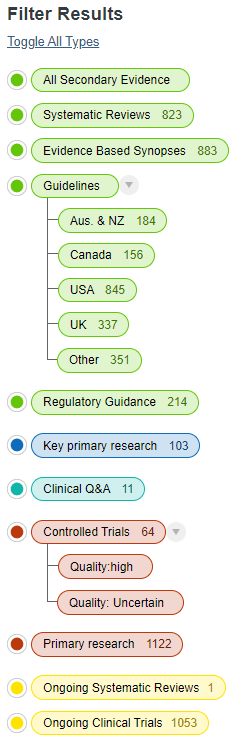
Trip offers a fairly basic interface, but you can filter results in a number of ways using the filters on the left-hand side. These include a filter for UK guidelines, making it easy to find any NICE guidance, along with guidance from Royal Colleges and other professional bodies. Trip claims to have the largest international collection of guidelines, and these can be filtered by region.

The filter for controlled trials offers an interesting feature whereby the RobotReviewer tool has been used to estimate the quality of trials as either 'high' or 'uncertain' based on the abstract, so a certain amount of critical appraisal has been carried out.

There are also filters for ongoing systematic reviews and clinical trials.

Although Trip Pro does not systematically search the journal literature, it does include a number of results classed as primary research, and these can be filtered to 'key primary research' or just 'primary research'. It's not clear how the distinction is made.

Trip offers a guide to which sources it searches.

Trip Pro searches a number of the resources that were covered by the NICE Evidence Search and is a partial replacement for it as NICE Evidence Search is closing at the end of March.