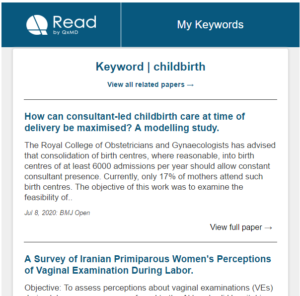
Get the latest tables of contents from your favourite journals

The KnowledgeShare service now offers you the ability to receive tables of contents for a wide range of healthcare journals.

The contents list of your chosen journals will be sent out once a month in a single email (so you won't get lots of separate emails). You can up by using the Evidence Updates form.

Any journal that is indexed in PubMed can be added to the tables of contents service, but unfortunately not all journals will be available if they are not included in PubMed.

It's an easy way to receive the latest contents from healthcare journals, but we also offer access to the Read by QxMD app as well, where you can also get details of the latest articles by following your favourite journals, keywords or collections.

Librarians give health professionals the 'gift of time'

We know that all healthcare professionals are short of time - time to be confident you have the most relevant, evidence-based information you need.

A recent report to an All-Party Parliamentary Group commissioned by HEE, Library and Knowledge Services Value Proposition: The Gift of Time, clearly outlines the true value of NHS Library and Knowledge Services having both a direct and indirect effect on the care patients receive. They make a positive impact on services as a whole, providing an economic value of millions of pounds to the NHS.

Health librarians and knowledge specialists make the gathering of information as easy as possible for you, relieving the burden of sourcing and synthesising evidence while enabling NHS organisations to meet their statutory obligations to get evidence into practice across the service.

Findings in a recently published international literature review suggest a return of £2.40 for every £1 spend on NHS library and knowledge services.

Patrick Mitchell, Director of Innovation and Transformation, Health Education England, said:

"This report gives us some truly great insight into the value that embedded NHS Library and Knowledge Services bring to staff at all levels of  the healthcare system when planning and delivering care for local people."

What is medRxiv?

medRxiv (pronounced med-archive) is one of a growing number of preprint servers where articles can be freely shared prior to peer-review and acceptance by a journal. It is jointly owned by Cold Spring Harbor Laboratory (CSHL), Yale University and BMJ, and was launched in 2019.

medRxiv covers medical, clinical, and related health sciences and accepts research articles (including systematic reviews and meta-analyses). It doesn't accept material such as narrative reviews or opinion pieces. 

Because the material submitted to medRxiv is unpublished, it's not indexed in databases such as PubMed until the article is later peer-reviewed and published in a journal. Preprints in medRxiv can however be found in Google and Google Scholar very quickly after submission.

When it comes to fast-moving topics such as COVID-19, preprint servers can make new research available very quickly, and reduce research waste from duplicated efforts and non-reporting. However, they can also add to the spread of poor-quality or misleading research due to the lack of peer-review, and should be used with care.

As medRxiv makes clear on each article's detail page:

'This article is a preprint and has not been peer-reviewed. It reports new medical research that has yet to be evaluated and so should not be used to guide clinical practice.'

medRxiv does do some screening checks on submitted articles, such as checking they are research-based, and checking for plagiarism and defamation. A researcher in a relevant field will check the basic content and organisation of the article, but medRxiv does not review a manuscript’s methods, assumptions, conclusions, or scientific quality.

If you intend to publish a research article, note that some journal publishers may not accept articles that have already been made available on a preprint server, so it's worth checking the policies of any journals you intend to submit the article to.

Further reading

Stay ahead of the latest journal articles with Read by QxMD

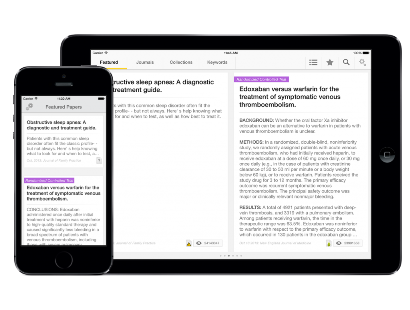
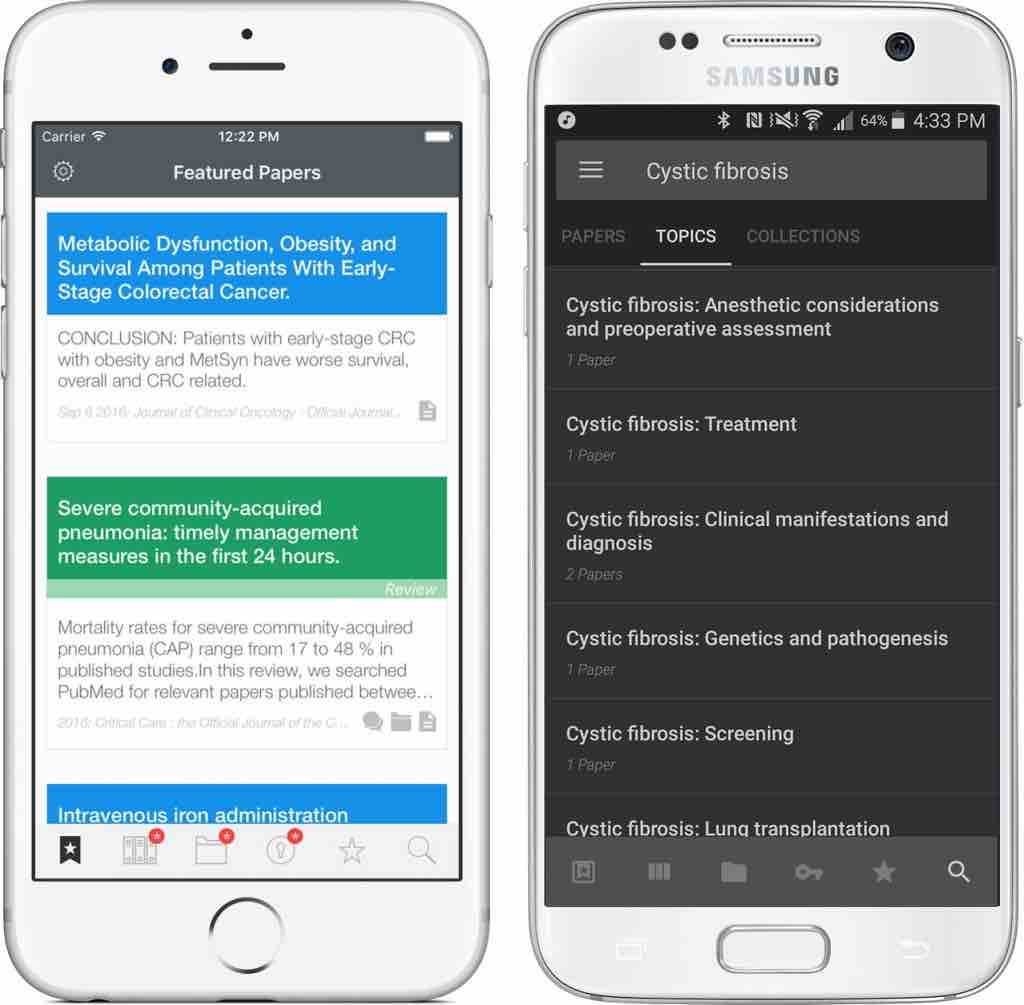
If you're looking for an easy way to see the latest articles in your favourite journals or on keywords of interest, Read by QxMD can help.


It's an app and website that tracks articles in healthcare journals and alerts you to new ones matching your interests. More than that, it can make finding the full-text easy as it links to our journal holdings, or locates open access copies. The app version can store your NHS OpenAthens account details - no more logging into OpenAthens each time you want to access an article!

It's free to create a Read by QxMD account, and you can link your account to the journal holdings of Shrewsbury and Telford Hospital NHS Trust, Shropshire Community Health NHS Trust, Staffordshire University or Keele University.

You can also add papers to your own virtual collections, recommend papers, and discuss articles.

Access research easily with LibKey Nomad

LibKey Nomad makes locating full-text journal articles easier, and is a free browser extension made available by NHS England. Once added, LibKey Nomad indicates if an article is available in full-text through the library. It works on many publisher websites, PubMed, and Wikipedia and adds links to access the full-text or PDF.

If there is no full-text access, LibKey Nomad will direct you to our article request form where it will add the article details for you to make requesting a copy via the library much easier.

Anatomy.TV interactive 3D anatomy resource

Anatomy.TV interactive 3D anatomy resource

You have access to the 3D Interactive Anatomy and the Functional Anatomy modules from the Primal Pictures' Anatomy.TV resource. Visit our Anatomy.TV page to find more information, and demonstration videos.

Access is via your NHS OpenAthens account on any device. We have five user licences, so we would ask that you please logoff after you have finished to allow other people to log on.

UpToDate clinical decision support tool

UpToDate is an evidence-based knowledge system that helps clinicians make the right decisions at the point of care. It contains over 11,000 articles, providing evidence-graded treatment recommendations as well as diagnostic and other information for common as well as rare conditions.

It is available to Shrewsbury and Telford Hospital NHS Trust staff and students, and can be accessed via the SaTH Intranet without a password. It can also be accessed off-site and via the UpToDate mobile app

Access e-books anywhere, anytime, on any device

You can easily access a collection of over 16,000 e-books on the ProQuest Ebook Central platform and these can either be viewed online, or downloaded to a mobile device for access anywhere.

To view an e-book online, you'll just need a free NHS OpenAthens account to login and then you can read the whole book.

If you want to download an e-book for offline reading, you'll need to install the Adobe Digital Editions app for Android or  iOS. This is a free app, but does require you to register for a free Adobe ID. You'll also need your NHS OpenAthens account to download e-books to your device.

Our guide to downloading e-books gives more details and also explains how to access chapters of e-books on dedicated e-book readers. Once you've got the app set up, you'll be able to download our e-books to your mobile device for up to 14 days for offline reading. If you need them for longer, simply download them again.

Here are some of the latest books added to the collection:

Support your mental health and wellbeing with these free apps

NHS staff have been given free access to a number of helpful apps until the end of December, to help you support your own mental health and wellbeing through this challenging time.  For more information on how to access these, visit the NHS Employers website.

Unmind

Unmind is a mental health platform that empowers staff to proactively improve their mental wellbeing. Using scientifically-backed assessments, tools and training you can measure and manage your personal mental health needs, including digital programmes designed to help with stress, sleep, coping, connection, fulfillment and nutrition.

Headspace

Headspace is a science-backed app in mindfulness and meditation, providing unique tools and resources to help reduce stress, build resilience, and aid better sleep.

Sleepio

Sleepio is a clinically-evidenced sleep improvement programme that is fully automated and highly personalised, using cognitive behavioural techniques to help improve poor sleep.

Daylight

Daylight is a smartphone-based app that provides help to people experiencing symptoms of worry and anxiety, using evidence-based cognitive behavioural techniques, voice and animation.

Finding improvement case studies

When looking at service development or improvement, the evidence can seem quite limited. In many cases other people may have implemented new ideas or services, but not written it up for publication in a journal.

The sources below provide case studies and examples of improvements or innovations, and may be useful as a way of learning from other people's experiences or getting ideas to implement in practice. It's not an exhaustive list and case studies will be available in other sources, such as individual Trust's websites.

Library staff can also find evidence to support you in developing services or innovations, and we offer an evidence search service.

Academy of Fabulous Stuff

Describes itself as ‘A social movement for sharing Health & Social Care Ideas, services and solutions that work’. Includes informal case studies of new innovations or ideas. The quality of reporting varies.

eWIN Workforce Information Network

eWIN is the NHS workforce information network designed to enable improvements in workforce development, efficiency and productivity.

To search, visit the Tools and Resources page, enter your search terms and select ‘Case Study’ before running the search.

Health Foundation

An independent charity committed to bringing about better health and health care for people in the UK. To find case studies, run a search and filter to ‘Improvement projects’.

NHS Confederation

Membership body that brings together and speaks on behalf of all organisations that plan, commission and provide NHS services.

To find case studies, run a search and filter to ‘Case studies’ (under ‘Category’) then click ‘Apply Filters’.

NHS England

Search the publications database, and filter to ‘Case studies’. This is a very small collection.

NHS Improvement

Visit the Resources page, run a search and filter to ‘Shared Learning’.

NHS Improvement and NHS England have merged so this website may change, but new resources are still being added as of February 2020.

NICE Local Practice Case Studies

A number of case studies around implementing NICE Guidance in practice.