
Access more information at any time with our new collection of e-books

Access to information anywhere, anytime, is even easier with our growing collection of e-books. We now have a new collection of 138 titles via Kortext, and these include a number of titles in the 'at a glance' series as well as many other titles covering medicine, nursing, allied health and midwifery.

All of them can be found via OmniSearch using the 'Books' tab (where you can also search all of our other books and e-books) or you can access the Kortext collection directly (click 'Collections' after logging in to see the whole range of books available). Access is via an NHS OpenAthens account.

Titles include...

...plus another 131 titles!

You can create a personal account to make it easier to login in future (and to enable you to use the mobile app). Visit the Kortext website, select your institution and login as normal with your NHS OpenAthens account. Logout by using the three dots at the top right of the screen and selecting 'Sign Out'. When the login screen appears again, select 'Forgotten Password?'. Use the email address linked to your OpenAthens account to get a password reset link.

Once you've reset your password, you can login to the website and mobile apps with your email and chosen password.

6 ways OmniSearch makes searching easier

Our OmniSearch facility has undergone a few changes recently, and is now even more powerful. Here are 6 reasons why.

1. You can now search books and e-books at the same time

2. You can even search books, e-books and articles at the same time!

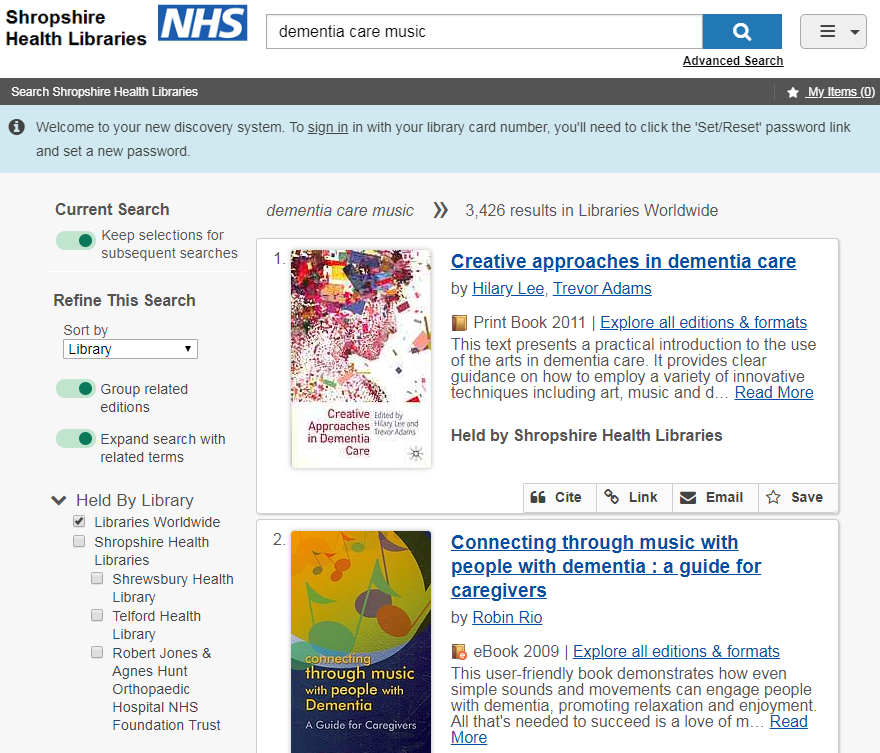
3. Books, e-books and articles are now searched using WorldCat Discovery, offering you new features such as book covers, citation tools, and easy filtering of results

4. The Article search finds articles in Medline, PsycARTICLES, ERIC, PubMed Central and the Cochrane Library so you don't have to search individual databases

5. The Evidence tab allows you to search Trip Database for various types of evidence (such as guidelines, systematic reviews or evidence summaries), the Cochrane Library (for systematic reviews and randomised controlled trials), BMJ Best Practice (for summaries of evidence) or the BNF/BNFc (for prescribing information)

6. Searches are carried from one search tab to the next so you can repeat the search in different resources quickly

For more information, visit our new OmniSearch guide.

Keep up to date with the latest COVID-19 evidence

We've just published the latest edition of our COVID-19 Evidence Bulletin, detailing the latest evidence, guidance and other resources to support the response to the pandemic.

This issue includes guidance from NICE on 'long COVID', and resources to support vaccinations.

The libraries are remaining open during the lockdown and there is no need to book ahead – you can drop-in, browse the shelves, use the IT and study individually. If you need to access the libraries when we are unstaffed, you may wish to arrange 24/7 access.

We have put measures in place to keep you and our staff safe – please read and observe these during your visit.

Librarians give health professionals the 'gift of time'

We know that all healthcare professionals are short of time - time to be confident you have the most relevant, evidence-based information you need.

A recent report to an All-Party Parliamentary Group commissioned by HEE, Library and Knowledge Services Value Proposition: The Gift of Time, clearly outlines the true value of NHS Library and Knowledge Services having both a direct and indirect effect on the care patients receive. They make a positive impact on services as a whole, providing an economic value of millions of pounds to the NHS.

Health librarians and knowledge specialists make the gathering of information as easy as possible for you, relieving the burden of sourcing and synthesising evidence while enabling NHS organisations to meet their statutory obligations to get evidence into practice across the service.

Findings in a recently published international literature review suggest a return of £2.40 for every £1 spend on NHS library and knowledge services.

Patrick Mitchell, Director of Innovation and Transformation, Health Education England, said:

"This report gives us some truly great insight into the value that embedded NHS Library and Knowledge Services bring to staff at all levels of  the healthcare system when planning and delivering care for local people."

What is medRxiv?

medRxiv (pronounced med-archive) is one of a growing number of preprint servers where articles can be freely shared prior to peer-review and acceptance by a journal. It is jointly owned by Cold Spring Harbor Laboratory (CSHL), Yale University and BMJ, and was launched in 2019.

medRxiv covers medical, clinical, and related health sciences and accepts research articles (including systematic reviews and meta-analyses). It doesn't accept material such as narrative reviews or opinion pieces. 

Because the material submitted to medRxiv is unpublished, it's not indexed in databases such as PubMed until the article is later peer-reviewed and published in a journal. Preprints in medRxiv can however be found in Google and Google Scholar very quickly after submission.

When it comes to fast-moving topics such as COVID-19, preprint servers can make new research available very quickly, and reduce research waste from duplicated efforts and non-reporting. However, they can also add to the spread of poor-quality or misleading research due to the lack of peer-review, and should be used with care.

As medRxiv makes clear on each article's detail page:

'This article is a preprint and has not been peer-reviewed. It reports new medical research that has yet to be evaluated and so should not be used to guide clinical practice.'

medRxiv does do some screening checks on submitted articles, such as checking they are research-based, and checking for plagiarism and defamation. A researcher in a relevant field will check the basic content and organisation of the article, but medRxiv does not review a manuscript’s methods, assumptions, conclusions, or scientific quality.

If you intend to publish a research article, note that some journal publishers may not accept articles that have already been made available on a preprint server, so it's worth checking the policies of any journals you intend to submit the article to.

Further reading

Stay ahead of the latest journal articles with Read by QxMD

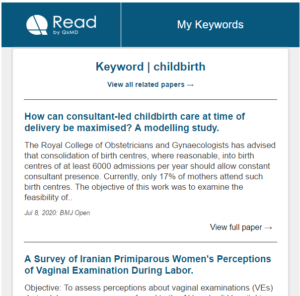
If you're looking for an easy way to see the latest articles in your favourite journals or on keywords of interest, Read by QxMD can help.

It's an app and website that tracks articles in healthcare journals and alerts you to new ones matching your interests. More than that, it can make finding the full-text easy as it links to our journal holdings, or locates open access copies. The app version can store your NHS OpenAthens account details - no more logging into OpenAthens each time you want to access an article!

It's free to create a Read by QxMD account, and you can link your account to the journal holdings of Shrewsbury and Telford Hospital NHS Trust, Shropshire Community Health NHS Trust, Staffordshire University or Keele University.

You can also add papers to your own virtual collections, recommend papers, and discuss articles.

Access research easily with LibKey Nomad

LibKey Nomad makes locating full-text journal articles easier, and is a free browser extension made available by NHS England. Once added, LibKey Nomad indicates if an article is available in full-text through the library. It works on many publisher websites, PubMed, and Wikipedia and adds links to access the full-text or PDF.

If there is no full-text access, LibKey Nomad will direct you to our article request form where it will add the article details for you to make requesting a copy via the library much easier.

Anatomy.TV interactive 3D anatomy resource

Anatomy.TV interactive 3D anatomy resource

You have access to the 3D Interactive Anatomy and the Functional Anatomy modules from the Primal Pictures' Anatomy.TV resource. Visit our Anatomy.TV page to find more information, and demonstration videos.

Access is via your NHS OpenAthens account on any device. We have five user licences, so we would ask that you please logoff after you have finished to allow other people to log on.

Access e-books anywhere, anytime, on any device

You can easily access a collection of over 16,000 e-books on the ProQuest Ebook Central platform and these can either be viewed online, or downloaded to a mobile device for access anywhere.

To view an e-book online, you'll just need a free NHS OpenAthens account to login and then you can read the whole book.

If you want to download an e-book for offline reading, you'll need to install the Adobe Digital Editions app for Android or  iOS. This is a free app, but does require you to register for a free Adobe ID. You'll also need your NHS OpenAthens account to download e-books to your device.

Our guide to downloading e-books gives more details and also explains how to access chapters of e-books on dedicated e-book readers. Once you've got the app set up, you'll be able to download our e-books to your mobile device for up to 14 days for offline reading. If you need them for longer, simply download them again.

Here are some of the latest books added to the collection:

Support your mental health and wellbeing with these free apps

NHS staff have been given free access to a number of helpful apps until the end of December, to help you support your own mental health and wellbeing through this challenging time.  For more information on how to access these, visit the NHS Employers website.

Unmind

Unmind is a mental health platform that empowers staff to proactively improve their mental wellbeing. Using scientifically-backed assessments, tools and training you can measure and manage your personal mental health needs, including digital programmes designed to help with stress, sleep, coping, connection, fulfillment and nutrition.

Headspace

Headspace is a science-backed app in mindfulness and meditation, providing unique tools and resources to help reduce stress, build resilience, and aid better sleep.

Sleepio

Sleepio is a clinically-evidenced sleep improvement programme that is fully automated and highly personalised, using cognitive behavioural techniques to help improve poor sleep.

Daylight

Daylight is a smartphone-based app that provides help to people experiencing symptoms of worry and anxiety, using evidence-based cognitive behavioural techniques, voice and animation.